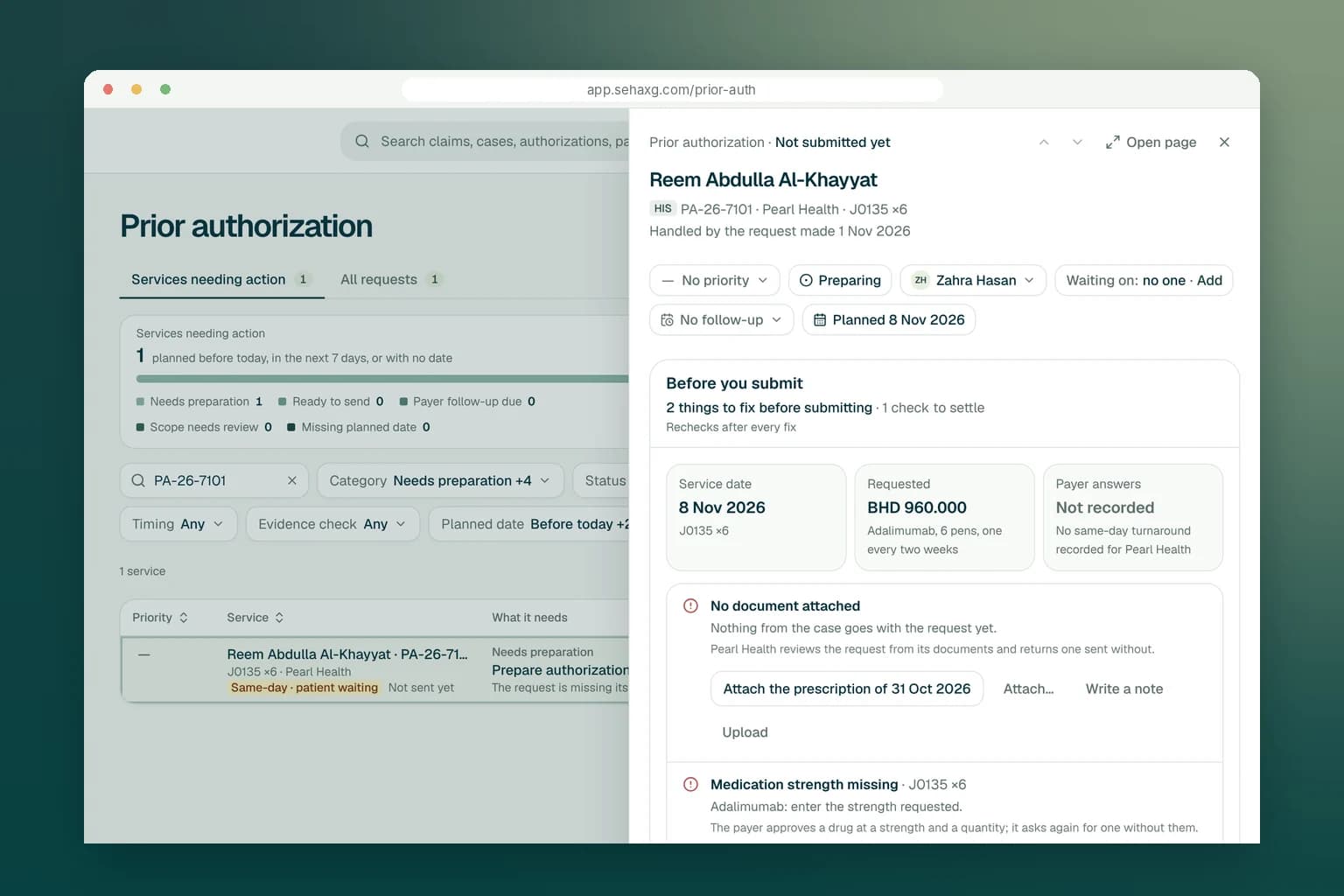
An active insurance card does not prove that a planned service is covered, within a benefit limit or approved. The practical question for a booking team is: what must be confirmed for this patient, service, insurer and date before care—and what evidence must travel with the claim afterward?
01 / COVERAGE LOGIC
Eligibility, benefits and approval are separate decisions
Eligibility asks whether the member and policy were active for a date. Benefit verification asks whether the planned service is covered under that particular plan, including network, limits, exclusions and patient share. Prior approval asks whether the insurer requires and has granted advance permission for the service as proposed. A positive answer to one does not answer the others. Store the exact question and response, not one combined green 'insurance verified' flag.
The distinction matters when talking to a patient. If membership is active but the benefit cannot be confirmed, staff should explain that the financial position is still being checked. If a service is covered but approval is pending, a booked appointment is not the same as an approved claim. Use language that reflects the known state and have a documented route for urgent clinical situations rather than letting a revenue workflow silently determine whether care proceeds.
02 / AT BOOKING
Check the person and the planned service
Confirm the patient's member details, insurer and plan, effective coverage on the expected service date, and whether the proposed service is within the applicable benefit. Record the time and source of the insurer response. A 'covered' response without the service, limit or network context may still leave a gap.
If the policy cannot be verified, set a named follow-up rather than marking the booking clear. When the service or date changes, repeat the relevant checks. A coverage response from last month may not answer today's question.
- Identity: member identifier, patient match and active plan.
- Benefit: service category, applicable limits, exclusions and patient share where available.
- Evidence: response source, timestamp and unresolved questions.
03 / BEFORE THE VISIT
Determine whether prior approval is needed
Ask the insurer's current rule for the exact service and plan. A requirement can vary by procedure, setting, provider or benefit type. If the rule is unclear, the team should see the uncertainty and seek confirmation rather than treating 'no answer' as 'no approval required.'
Where approval is needed, assemble the requested clinical and administrative evidence, identify who can sign or attest to it, and submit through the insurer's authorized channel. Track the reference and approved scope, not just the fact that a request was sent. A pending request is not an approval.
04 / OPERATING CADENCE
Put each check where it can still change the outcome
At booking, verify the member, plan, proposed service and whether an approval route is required. Before the visit, gather required clinical records and submit a complete request early enough for the insurer's stated turnaround. Near the visit, recheck pending items, approved dates and units, and any change in clinician or procedure. After care, reconcile the delivered service against the approval before the claim is released.
Every hand-off needs an owner and evidence of the insurer response. A scheduler may identify a coverage question, but a prior-approval specialist owns the submission and a clinician owns the medical rationale. A biller should be able to see the final decision and reference without hunting through an email thread. The process fails if a correct decision exists but cannot be found when the claim is built.
- At booking: capture plan, service, date and unanswered benefit questions.
- Before care: submit evidence, track status and communicate unresolved patient-cost questions.
- Before claim release: match delivered service, approval scope and reference.
05 / STATUS AND DELAYS
Give every pending approval a next action
Pending, denied, questioned and expiring approvals need different responses. For a request awaiting more information, route the exact missing item to the clinical owner. For a denial, compare the insurer's reason with the submitted evidence and the applicable policy. For an approval near expiry, recheck service dates and units before the appointment.
A simple worklist should show patient and service identifiers to authorized staff, insurer, request date, status, insurer reference, next deadline and owner. It should not expose clinical details in an ordinary notification or assume that an automated status check replaces human review of the decision.
The approval exists, but the claim cannot see it
A clinic receives approval for an imaging service, then changes the appointment date. The team verifies whether the approved date range still covers the visit, links the final approval reference to the claim and checks that the requested service matches what was actually delivered.
Make a pending approval actionable
Suppose twenty appointments are approaching and six approval requests are still pending. sehaXG can group those six by insurer and visit date, show the last response and identify the exact missing evidence or decision. An approval specialist can assign a clinical-document request, follow up through the authorised channel and keep the status visible to the booking team.
When approval arrives, the team can check its service, units and date range against the planned visit and carry the reference into claim readiness. A pending request remains pending on screen; it is never displayed as permission to bill.
See the revenue-cycle workflow06 / EXCEPTIONS
Recheck when the service, setting or dates change
Approvals can be specific to a service, number of units, provider, facility or date range. When a clinician changes the intended procedure, a visit is rescheduled, or the patient's plan changes, compare the new facts with the original decision and ask the insurer which amendment route applies. Do not copy an old reference onto a new claim merely because the patient and specialty match.
For a denied or partially approved request, preserve the insurer's reason and route the clinical question to the qualified owner. For urgent or unplanned care, use the insurer's applicable emergency or retrospective process only when confirmed; do not present it as a universal exception. If a patient chooses to proceed while coverage is unresolved, communication and consent should follow the hospital's policy and applicable rules, not an improvised warning in a booking note.
07 / AFTER THE VISIT
Close the hand-off before submission
The approval decision must reach the claim with the right patient, service, dates and reference. If the scope differs from the delivered service, flag the mismatch before submission. The final check is not a new form to complete; it is a link between decisions already made and the claim about to be sent.
sehaXG's target workflow connects eligibility, prior approvals, clinical evidence and claim readiness. Each hospital still needs its own insurer rules, authorized integration route and review policy confirmed before automated checks or submissions can be treated as live.
08 / MEASUREMENT
Measure the hand-off, not just request volume
Track the share of scheduled services with a documented eligibility response, the share of approval-required services submitted with complete evidence, time from request to decision and the number of visits with unresolved status. Then connect approvals to claims: how often did a valid approval reference reach submission, and how many denials occurred despite one being on file? These measures reveal different failure points.
Review a sample of exceptions each month. A low approval-denial rate can conceal delayed visits or excessive staff work; a high 'approval obtained' rate says little if the approved scope was wrong. Start with one insurer and service where volumes are meaningful, fix the largest hand-off gap, and compare the same cohort after the change. Avoid attributing every denial reduction to an approval workflow when payer policy or service mix also changed.
THE NEXT STEP
Move the check earlier
A reliable pre-visit process protects both the patient conversation and the eventual claim. Start with one high-volume service and insurer, document the real approval requirements, then measure how often the reference survives intact into submission.