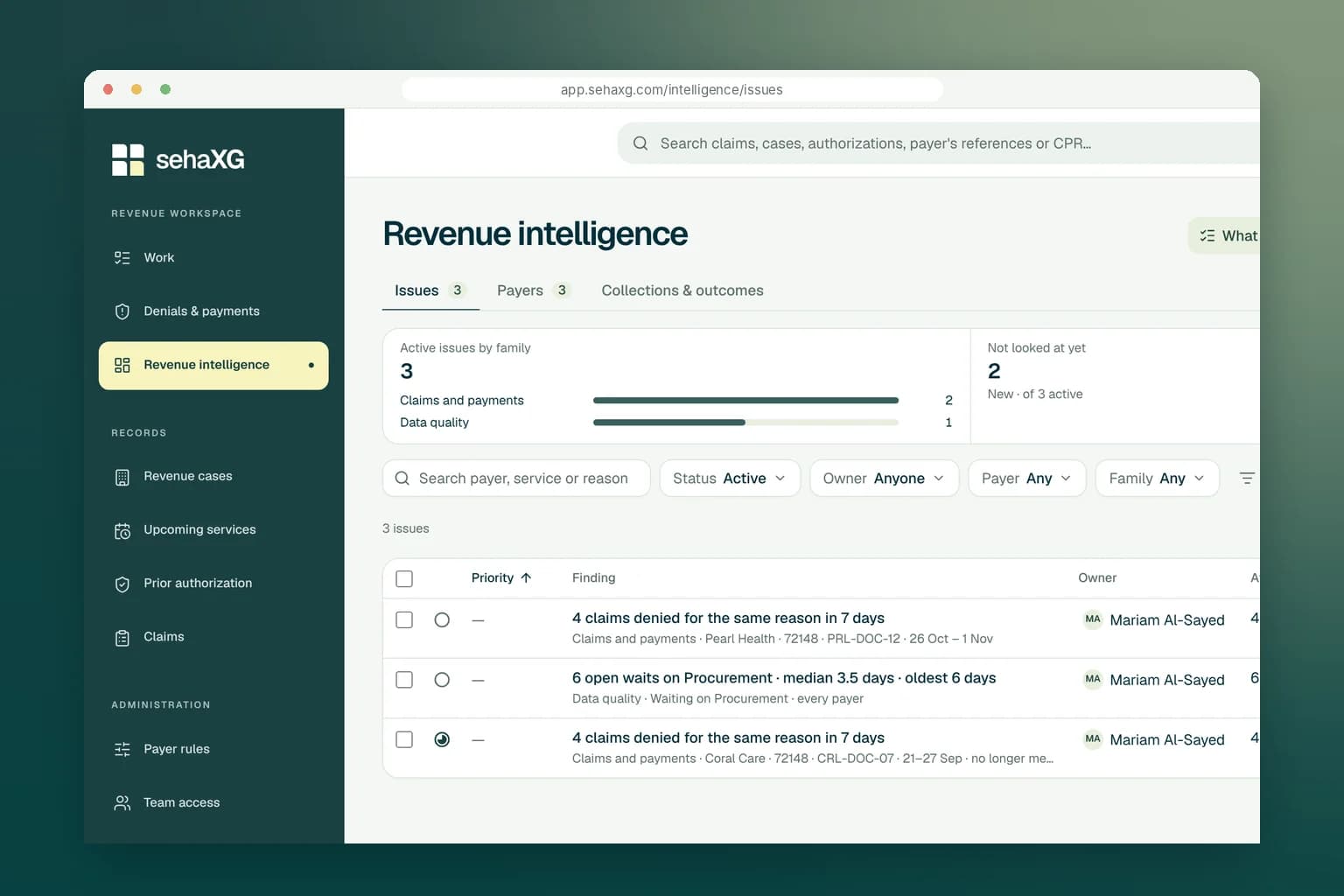
Revenue intelligence is the discipline of turning revenue-cycle records into a specific, testable decision. It asks not only how many claims were denied or how much cash arrived, but which payer, service and process caused a change; what BHD is genuinely at risk; and who can do something about it. It works alongside ordinary reporting, not in place of it.
01 / THE IDEA
An answer a team can use, not another chart
A useful intelligence finding contains a defined group of claims, a comparison period or contractual expectation, evidence for the difference and a proposed action. 'Denials rose this month' is a report. 'Approval-related denials rose for one insurer after an appointment system change; 26 affected claims have valid approvals on file but no reference on the submitted claim' is a finding a team can investigate and repair.
The system must preserve uncertainty. An increase may reflect more claim volume, a new service line or a missing remittance file rather than a payer change. Before a finding reaches a worklist, someone should be able to inspect the underlying records and see how the amount and rate were calculated. The aim is faster judgment with better evidence, not automatic certainty.
02 / THE INPUTS
Join the claim to the decisions around it
The claim alone rarely explains why payment stalled. Link the patient and encounter identifiers to eligibility responses, prior-approval decisions, the submitted claim version, insurer acknowledgements, denial or adjustment reasons, contract terms and remittance lines. Use only the patient information needed for the task and follow the hospital's access and data-handling rules.
Reliable joins matter more than an elaborate model. A missing approval reference can make a valid approval look absent; a payment attached to the wrong claim can create a false underpayment. Show unmatched records as exceptions instead of filling gaps with guesses. Record the contract version and service date, because a current fee schedule may not describe an older claim.
- Before submission: coverage, benefit, approval, service and evidence.
- After submission: claim version, receipt, payer response and deadline.
- After payment: allowed amount, patient share, insurer payment and adjustments.
03 / THE DISTINCTION
Use a dashboard to notice; use investigation to decide
A dashboard is good at showing trends in denial rate, days in accounts receivable and cash collections. It may show that denials moved from 3% to 5%. Intelligence asks whether the numerator, denominator and service mix are comparable, which subset moved, whether the change is new and what operational step could affect the next claim. Reporting remains the baseline against which a later intervention is judged.
For example, an overall rise could be driven by one high-volume clinic or one new insurer policy. The appropriate response might be a corrected eligibility feed, a better prior-approval hand-off, a claim edit or a payer conversation. Without segmenting the trend and checking sample claims, a generic 'reduce denials' target may direct staff to the wrong work.
04 / IN PRACTICE
A paid claim can still point to a wider issue
Suppose one Bahrain hospital notices that payment for an outpatient service fell from BHD 80 to BHD 73 on 120 recent claims. The simple difference is BHD 7 per claim, or BHD 840 in apparent exposure. Before opening a recovery case, compare the service dates with the effective contract, patient share, units, plan tier and any later remittance adjustments. The headline gap is a lead, not a confirmed underpayment.
If 90 claims remain comparable and no agreed adjustment explains the difference, the team can assemble the relevant contract clause and remittances for an insurer inquiry. It can also check whether the same rule affects new claims. This is the intelligence loop: find a pattern, validate a subset, quantify defensible BHD, choose a remedy and confirm whether actual payment changed.
Potential is not recovered
BHD 840 is an initial calculation. Validated exposure, amount submitted for review, payer acknowledgement and cash posted should be reported separately.
From a BHD 7 signal to a defensible case
In sehaXG, the hospital can open the service-level payment change and see the claims behind it, grouped by insurer, plan and contract period. The team can compare expected and actual insurer payment, inspect the remittance and exclude claims with valid patient share before deciding which of the 120 cases need review.
The validated group becomes an owned worklist with the relevant contract context and inquiry deadline. When the insurer responds, sehaXG keeps the decision and new payment next to the original signal, so the team can report BHD recovered rather than only BHD detected.
Explore sehaXG Intelligence05 / THE WORKLIST
Rank by recoverable value, urgency and readiness
An issue with a large billed balance may be unworkable if the contract is missing or a clinical decision is needed. A smaller correction with an approval on file and a deadline tomorrow may be the better first task. Show why a case is prioritised: validated insurer share, deadline, evidence available, likely remedy and whether the same fix applies to a cohort.
Assign an owner and completion condition. 'Alert viewed' is not completion. A corrected claim needs acceptance; an appeal needs a decision; a payment inquiry needs a remittance match. If an insurer rejects the proposed remedy, the finding should return to investigation rather than remain green in a dashboard. Track staff overrides because they expose missing information in the priority rule.
06 / ASSISTANCE
Let AI reduce searching without hiding the evidence
AI can help group similar payer responses, summarise claim histories, draft a case note and suggest which documents a reviewer needs. Those are useful only when the output links back to the actual claim, approval and policy. A generated explanation must not replace the source record, and a suggested code or clinical rationale must go to a qualified person before it changes a claim.
Digital agents can also prepare repeatable tasks such as status checks or documentation packages within agreed permissions. Preparation, approval, external submission and verified outcome are different states. Hospitals should pilot narrow workflows, measure false matches and missed deadlines, and expand authority only when the relevant integration and human controls have been tested.
07 / PROOF
Look for decisions and payments that changed
A useful scorecard separates alerts generated from alerts validated, claims acted upon, deadlines met and BHD actually recovered or protected. Include time from signal to action and time from payer response to payment. Compare the same insurer and service cohort before and after a workflow change; a better result can also come from changed volume, contract terms or coding mix.
Review false positives and the claims the system missed. If analysts spend hours dismissing weak alerts, the tool may be creating work rather than removing it. If a valid pattern is found but no one owns the remedy, improved visibility alone has not improved the revenue cycle. Revenue intelligence succeeds when it helps a team reach a defensible decision sooner and verify what happened afterward.
08 / FIRST PILOT
Choose one costly question and trace it end to end
Start with a question such as 'Why are approval-related denials rising for this insurer?' or 'Which paid claims fell below the contracted amount this month?' Identify the records needed, agree on the payer and service cohort, validate ten to twenty examples and establish a baseline. Then define the response owner and the point at which the case is considered resolved.
Only add automation after the underlying records and decision route are reliable. A short pilot can reveal whether the main obstacle is data matching, insurer rules, staff hand-offs or an unclear contract. That knowledge is more valuable than launching a broad dashboard that cannot tell the team which claim to work tomorrow.
THE NEXT STEP
Connect insight to a verified outcome
The question is not how many charts the team has. It is whether an unusual signal can be traced to evidence, assigned to the right owner and followed through to a claim or payment outcome. That is the work sehaXG is built to support.