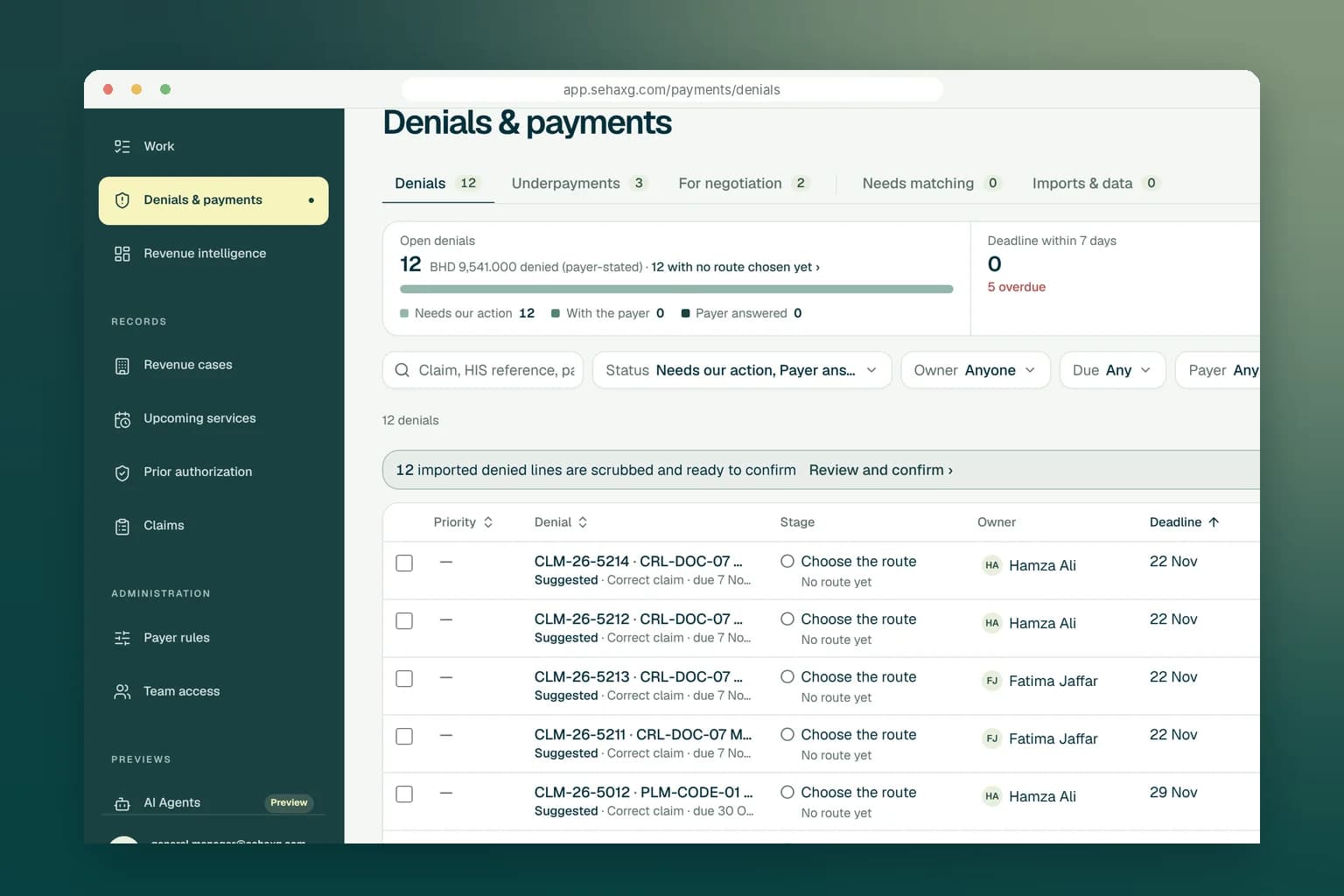
Start by asking what the insurer actually rejected, whether the decision is correct, and which deadline governs the next action. A claim that needs one corrected field should not enter the same workflow as a disputed coverage decision. Treating every denial as an appeal wastes time; treating every denial as final leaves recoverable revenue behind.
01 / DO NOT MIX THE QUEUES
A rejected submission is not an adjudicated denial
First establish where the claim stopped. A file rejected at the submission gateway may never have entered the insurer's adjudication process; the repair is often a format, identifier or transmission correction. An adjudicated denial is a payer decision on a received claim. A partially paid claim can require a line-level appeal or payment inquiry without resubmitting the whole encounter. Mixing these states produces duplicate claims and missed deadlines.
Maintain the original submission identifier, acknowledgement, insurer claim number if assigned, corrected version and every payer response. A correction should reference the prior claim in the manner the insurer requires. If staff cannot determine whether the first submission was accepted, confirm its status before sending a second copy. Otherwise a well-intended recovery action can create an avoidable duplicate denial.
- Rejected: find the failed validation, repair the payload and confirm technical acceptance.
- Denied: read the decision, contract and evidence before choosing correction or appeal.
- Partially paid: reconcile each line and adjustment before asserting a remaining balance.
02 / FIRST RESPONSE
Classify before you write an appeal
Read the insurer's response alongside the original claim, approval record, coverage details and remittance. Note whether the whole claim or only a line was affected. Preserve the insurer's original wording and code, but translate it into a plain-language reason your team can act on.
There are three common routes. A claim rejected for a missing or mismatched field may need correction and resubmission. A denial based on an approval or coverage decision may need evidence and a formal challenge. A correctly denied, non-recoverable claim may need an adjustment or patient-billing review under the applicable contract. The route depends on the actual insurer policy, not a universal denial-code lookup.
- Correct: the data was wrong or incomplete, and the insurer accepts a corrected claim.
- Appeal: the service, approval or contract evidence supports a different decision.
- Close or escalate: the insurer is correct, the deadline has passed, or a clinical or contractual judgment is required.
03 / TIME LIMITS
Create a deadline map before choosing a route
The next action may be governed by different clocks: a correction window, an appeal period, a request-for-information deadline or a contractual filing limit. Capture the date the insurer received the original claim, the date and channel of the denial, the deadline source and any proof that a submission was made in time. Do not assume every payer counts calendar days the same way or that a portal message pauses a clock.
Give the owner an internal due date with time to gather records and obtain clinical or contract review. If the packet cannot be completed by then, escalate the missing decision immediately. A worklist should show both the external deadline and the dependency blocking progress—for example, an unsigned note, missing approval record or contract clause—not simply a red overdue badge.
04 / THE CASE FILE
Make the next reviewer’s job easy
A useful recovery file identifies the claim and affected line, insurer and plan, service date, original submission, denial response, relevant approval and supporting clinical document. For a payment dispute, attach the contract term and the calculation of expected versus actual payment. For a documentation dispute, identify the exact evidence that answers the insurer's reason.
Check the payer's submission channel, format, appeal window and permitted correction route before acting. Record a single accountable owner and a due date earlier than the external deadline. Where the clinical record is ambiguous, ask the treating team rather than having software infer a diagnosis or change a code silently.
05 / APPEAL QUALITY
Answer the insurer's reason, line by line
An appeal is strongest when it states the exact decision being challenged, the requested remedy and the evidence that directly answers the insurer's reason. Identify the affected claim and line, member and service dates; quote or identify the relevant policy or contract language; then connect each supporting document to the disputed point. A large attachment bundle without that map forces the reviewer to reconstruct the case and makes a preventable request for more information more likely.
Keep clinical assertions with the treating or qualified coding team. Revenue staff can assemble the record, calculate exposure and check completeness, but should not infer medical necessity from an AI summary. Where the insurer's reason is ambiguous, ask for clarification and preserve the response. If several claims share a rule, prepare a cohort summary plus claim-specific evidence rather than sending an identical letter that ignores individual facts.
06 / WORKED EXAMPLE
One missing reference, two different jobs
Suppose a Bahrain clinic has 40 outpatient claims for one insurer, each expected to bring BHD 75. Twelve are denied because the submitted claims lack an approval reference. The immediate exposure is 12 × BHD 75 = BHD 900; that is not yet a confirmed loss. First check whether valid approvals exist for those twelve services.
If they do, the recovery job is to attach or reference them through the insurer's allowed correction path and confirm receipt. The prevention job is different: trace why the approval identifier did not pass from scheduling or prior approvals into the claim. If approvals were never obtained, the team needs an eligibility and approval review, not a fabricated reference or a generic appeal.
Was the approval obtained?
Yes: repair the claim and preserve the original approval. No: confirm the insurer's retrospective options and fix the pre-visit workflow. In both cases, log the outcome so the next batch is not sent with the same defect.
Give the twelve claims two clear routes
In sehaXG, the team can open the twelve approval-reference denials as one cohort and see which claims have a matching approval on file. The cases with a valid reference are prepared for the insurer's permitted correction route; the others go to an approval specialist for review rather than receiving a made-up number.
The worklist records an owner, deadline, submission receipt and eventual remittance for each claim. The same pattern is linked back to the broken booking-to-claim hand-off, so fixing today's BHD 900 exposure also helps protect the next batch.
Explore sehaXG Orchestration07 / CLOSE THE LOOP
Submission is not resolution
After a corrected claim or appeal goes out, capture the receipt or reference number and check for acknowledgement. Follow status until the insurer issues a decision and, if successful, the remittance is matched to the claim. A sent email or portal upload is not recovered revenue.
Finally, group similar denials by insurer, service, location and cause. A spike may justify a claim edit, an earlier approval check or a documented conversation with the insurer. Measure whether the targeted pattern falls after the change; do not declare success from one paid claim.
08 / OUTCOME ACCOUNTING
Separate exposure, submitted appeals and cash recovered
Use a simple ledger for each denial cohort: amount originally at risk, amount found ineligible after review, amount corrected or appealed, amount accepted for reconsideration, amount paid, and amount still open. These figures answer different questions. BHD 900 in potentially affected claims does not become BHD 900 recovered when a correction is uploaded; it becomes recovery only when the new remittance is matched and the remaining balance is explained.
Review appeal overturn rates by reason and insurer, median days to acknowledgement and payment, percentage of deadlines met and repeat-denial rates after an upstream fix. Pair the numbers with a small sample of files: an apparently high success rate can hide a policy of working only easy claims, while a falling denial rate can reflect a changed service mix. The management question is whether the process improves both valid recovery and first-pass claim quality.
THE NEXT STEP
Work the claim and the cause
The best denial process has two outputs: a verified decision on the affected claim and a specific upstream fix when the cause repeats. sehaXG brings the claim, evidence, appeal work and payer pattern into one reviewable workflow so teams can decide what to do next.