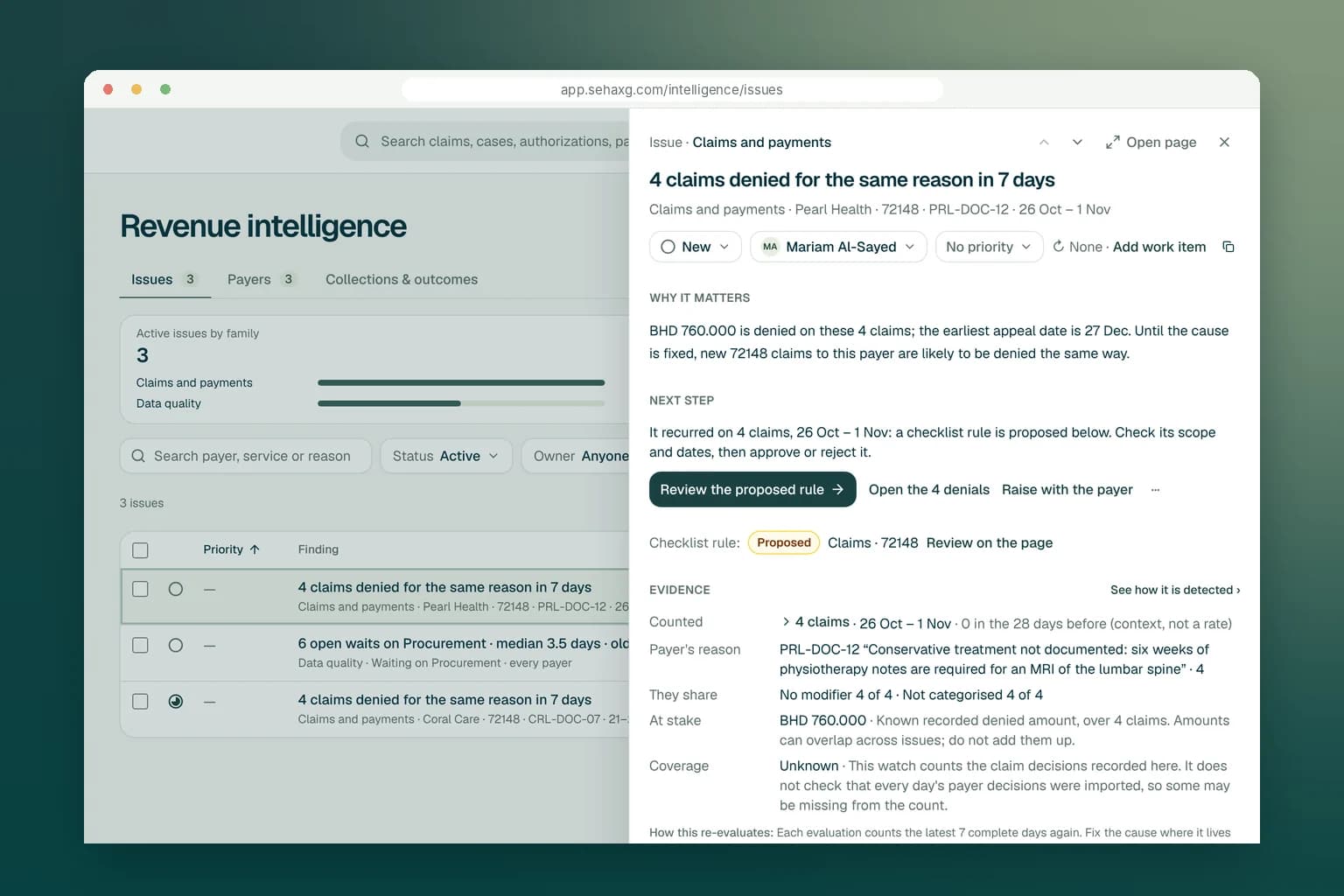
Claim denials rarely announce themselves as a system-wide problem. They start as a few exceptions, then repeat across a payer, procedure, facility or missing document. A team that sees the pattern early has a chance to correct the cause—not just work the queue it leaves behind. When that correction applies to every future claim, a small improvement can have a much larger effect.
01 / THE PROBLEM
Why claim denials become revenue roadblocks
Think of the revenue cycle as a journey with several checkpoints: eligibility, prior approval, coding, submission, adjudication and payment. A breakdown at one checkpoint can delay every claim behind it. By the time a monthly report shows a higher denial rate, another batch may already be following the same route.
Some denials come from a new or newly enforced insurer requirement. Others begin inside the organisation: a document was not attached, an approval reference did not reach the claim, or a manual field was entered inconsistently. Not every denial is preventable, but recurring causes are often visible before they become a large backlog.
The challenge is not simply collecting more reports. It is connecting the relevant signals quickly enough to decide who should act, on which claims, and before which deadline.
02 / THE EARLY SIGNALS
Watch the work before it becomes a denial queue
A useful alert should reveal a change that a person can investigate, rather than repeat a number already visible on a dashboard. Three types of signal deserve attention:
- Denial patterns: A reason code, insurer, service, location or clinician group begins behaving differently from its recent history. The alert should show the common factor and the claims already affected.
- Productivity and submission flow: A sudden drop in submitted claims, a growing hold queue or repeated validation errors may mean work is stalled before the insurer even receives it. A rejection at this stage is not the same as a denial after adjudication, but both slow payment.
- Accounts receivable: Claims approaching an appeal or follow-up deadline, ageing balances and delayed remittances tell the team where waiting has a cost. The most useful view combines urgency with the amount at stake and the likelihood that action can change the outcome.
These signals are more powerful together. If submissions for one insurer fall while its claim holds rise, the team may need to fix an upstream process—not simply assign more people to denial follow-up.
03 / A BAHRAIN EXAMPLE
From a pattern to the next useful action
Imagine a Bahrain clinic sees more denials for an outpatient service from one insurer. The common thread is a missing prior-approval reference in the submitted claim. A generic alert—“denials increased”—still leaves the team to do the investigation. An actionable alert connects the denial reason to the insurer, service, affected claims and pending claims with the same missing field.
The team can then confirm the insurer's requirement, check whether approvals exist but are not flowing into submissions, repair the hand-off, and review the pending batch. Already denied claims can be routed for correction or appeal where appropriate. The alert does not decide that every claim is recoverable; it makes the evidence and next step easier to see.
The goal is not an inbox full of alarms. It is an earlier, clearer decision: fix the cause, protect the next batch, and give affected claims an owner.
04 / THE PRODUCT
Meet sehaXG Intelligence
sehaXG Intelligence brings claims, prior approvals, denials, remittances and accounts receivable into one revenue view. Its dashboards let leaders monitor performance across insurers, services and locations, then drill into the claim-level evidence behind a change. That is the difference between seeing a denial rate and understanding what is driving it.
Intelligence also compares accounts receivable (A/R) by insurer, service and age of balance with each group's recent history. Imagine a Bahrain hospital sees balances unpaid for 61–90 days rise BHD 18,000 above their usual level. The team can open the affected claims to see whether one insurer, a recurring denial reason or delayed remittances explain the change, while checking claim volume before assigning blame. That BHD movement is a prompt to investigate—not confirmed lost revenue—and the evidence directs the next follow-up or process fix.
The intelligence layer continuously looks for shifts in payer behaviour and internal workflow. It groups related exceptions, estimates which pending claims may face the same issue, and surfaces the likely root cause. Predictive risk is a prompt to review—not a guarantee that an insurer will deny a claim.
From there, sehaXG turns insight into a prioritised worklist. Each alert connects the pattern to affected inventory, possible BHD exposure, the relevant evidence, an accountable owner and a recommended next step. A team member can confirm the cause, approve a correction, assign follow-up or escalate an uncertain case. The outcome feeds back into the dashboard, so the team can see whether its fix actually reduced the problem.
Those recommendations can point beyond the current queue: a claim-scrubbing rule, a refresher on an insurer's coding guidance, an earlier approval or eligibility check, or a recurring coverage issue to raise during contract review.
This is where intelligence becomes operational. Executives can track denial and collection trends. Managers can see which insurer or workflow needs attention. Billers and revenue-cycle teams can open the exact claims to work next, rather than reconstructing the story from separate systems.
05 / DESIGNING THE ALERT
What a useful revenue-cycle alert should contain
An alert earns a place in a busy team's day when it answers four questions without another hour of analysis:
- What changed? Show the movement against a relevant baseline, with the insurer, service and time period.
- Why might it be happening? Identify the shared denial reason, missing document, approval gap or submission error—and make the supporting claims inspectable.
- What is at stake? Separate already denied inventory from pending claims, and show BHD amounts as exposure to review rather than guaranteed lost revenue.
- Who should do what next? Give the right team a practical action and deadline, then record whether the issue was confirmed, resolved or dismissed.
That last step matters. An alerting system should learn from the team's decisions and make repeated noise less likely, while keeping people in control of consequential claim and clinical judgments.
06 / THE UPSTREAM FIX
Small process fixes can protect the next batch
The value of an alert is not limited to the claims it finds. Once a team confirms the cause, it can change the step that keeps producing the same exception. Three common paths show how that works.
Claim errors: correct the rule, not just the claim
If denials begin to cluster around a billing code for one insurer, sehaXG Intelligence can surface the affected claims and the shared pattern. The team checks current coding and insurer guidance before deciding what changed. It can then add a claim-scrubbing rule in its billing workflow, so the same error is flagged before submission, and brief staff on the requirement. The next batch shows whether the fix holds.
Prior approvals and eligibility: move the check earlier
A run of denials for missing approvals may point to an authorisation not obtained, a reference not carried onto the claim, or evidence sent to the wrong destination. Eligibility denials may reveal that coverage was not confirmed at the right time. Intelligence separates those causes and recommends an earlier check at scheduling or claim preparation. Where the organisation's systems allow, teams can automate a defined approval or eligibility check; a new data connection is scoped with the provider rather than assumed to exist.
Insurer contracts: bring the pattern to the negotiation
If an insurer repeatedly denies a service because it is not covered under the current agreement, resubmitting the same claim is unlikely to solve the underlying issue. sehaXG Intelligence can group the cases by service, insurer and reason and show the BHD value of the affected activity. Finance and contracting teams can use that evidence to discuss coverage, documentation requirements or rates at the next insurer review. That does not make existing excluded claims payable; it gives the organisation a clearer case for changing future terms.
A cleaner claim rule, a timely approval check or a better contract clause may look modest on its own. Repeated across hundreds of claims, each can reduce avoidable rework and make collections more predictable.
07 / THE TAKEAWAY
Start with the roadblock you can see
Choose one recurring denial reason or one insurer with a growing hold queue. Trace a small sample from approval and submission through decision and payment. Ask whether the cause is a changed requirement, a broken hand-off or an avoidable data error. Then make the fix visible in the next batch and measure whether the pattern changes.
The same approach extends beyond denials to underpayments, submission delays and ageing accounts receivable. For a broader view, explore our guides to revenue intelligence and insurer behaviour.