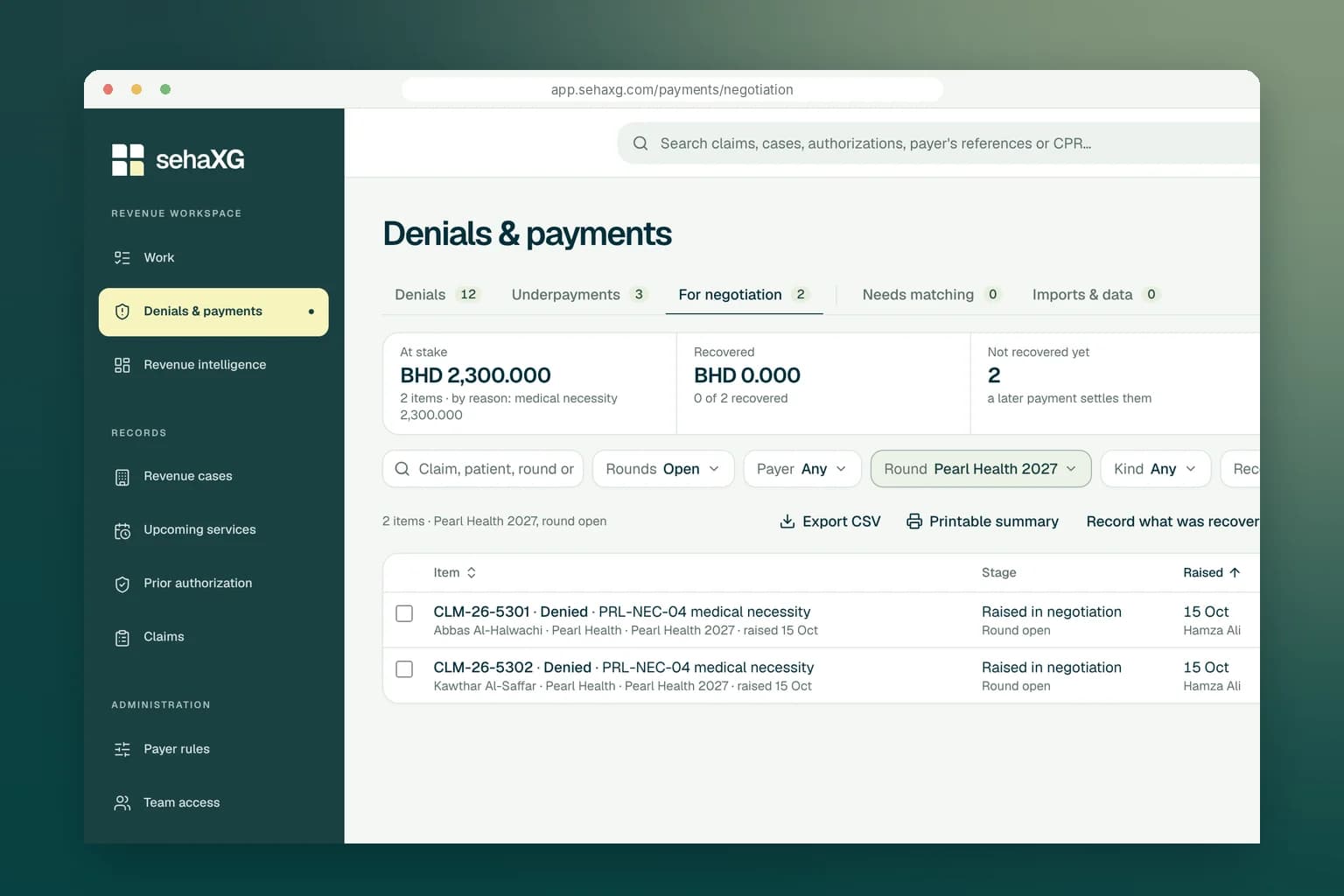
The strongest insurer conversation begins before the meeting. Revenue teams need to distinguish an internal billing error from a payer rule change, a contract ambiguity and a true reimbursement dispute. The brief should show the size of the problem, the evidence behind it and the specific change being requested.
01 / SCOPE
Choose a pattern the insurer can verify
Start with one insurer and plan, service family and time period. Count submitted claims, affected claims, denied amount and the distinct denial reasons. Segment by facility, clinician or submission route where that could explain the pattern. A raw increase in denials may simply reflect more claims; compare rates as well as counts.
Keep rejected submissions, post-adjudication denials and paid-but-underpaid claims separate. They may all reduce cash flow, but they have different evidence and remedies. Link each aggregate back to the claim-level records so the insurer can examine a sample.
02 / ANALYTIC METHOD
Control for volume and service mix
Compare like periods and like services. If a clinic doubled its submissions, an increase from 20 to 30 denials may coexist with a lower denial rate. If a new service line began during the quarter, the aggregate rate may move without any change in payer behaviour. Show submitted claims, adjudicated claims, denial counts and rates, expected BHD and actual payment for the affected cohort and a relevant comparison period.
Check whether coding, provider mix, facility, contract version or submission channel changed at the same time. Segment the data until the hypothesised payer issue remains visible. A simple timeline of the first affected claim, any insurer guidance and the corresponding denial reason is often more persuasive than a large dashboard screenshot. Label inferred causes as hypotheses until the records support them.
03 / CONTRACT
Put the agreement beside the data
Find the contract version and effective date that apply to the affected services. Identify the coverage, approval, documentation, rate, filing and appeal terms relevant to the issue. A denial trend does not prove an insurer breached a contract. First test whether internal claim quality, eligibility or approval hand-offs explain the pattern.
If the insurer introduced or began enforcing a requirement, establish when the change appeared in its published guidance or written correspondence. Where that evidence is unavailable, label the change as a hypothesis. The negotiation brief should be more credible than the dashboard that triggered the investigation.
- Pattern: what changed, for which services and from what baseline?
- Term: which clause or guidance is in question, and when did it apply?
- Remedy: reprocess claims, clarify a rule, amend a clause or change an internal process?
04 / BHD EXPOSURE
Use a defensible amount, not the biggest number
Suppose 80 claims for a service were denied in the quarter and the expected insurer payment was BHD 45 per claim. BHD 3,600 is the maximum apparent exposure if all 80 were otherwise payable. It is not automatically recoverable: some may be duplicates, outside contract scope or correctly denied.
A stronger brief shows the validated subset, average time to payment, appeal success and the amount already recovered. If 20 of the 80 were corrected and paid, separate those BHD 900 from still-open cases. Add the staff effort and patient impact only where measured; avoid claiming a clinical outcome from a revenue report.
Ask for one specific change
For example: 'These 30 claims share the same documentation denial, despite the attached evidence required by section X of the current agreement. Please review the attached sample, clarify the submission rule and confirm the route for reprocessing the remaining cohort.'
05 / MEETING PACK
Bring a packet that supports one decision
A practical brief opens with one sentence stating the issue and the requested remedy. Follow it with the cohort definition, denominator and time period; a before-and-after trend; the relevant contract or payer language; three to five representative claims; a list of exceptions excluded from the calculation; and a BHD exposure range with its assumptions. Include the internal checks already performed so the insurer does not have to ask whether the approval references or coding were valid.
Keep patient information to the minimum needed for the agreed review channel. The high-level meeting deck can use aggregates; claim-level documents belong in the authorised secure exchange. Assign one person to explain contract interpretation, one to answer operational claim questions and one to capture decisions. A brief is not complete until it states who will send the remaining cohort and who will confirm payment.
- Evidence: defined cohort, source records, applicable terms and representative claims.
- Impact: validated BHD at issue, timing and unresolved balance—not billed charges alone.
- Request: specific reprocessing, clarification, amendment or operational fix.
Walk into the insurer meeting with the disputed cohort ready
sehaXG can bring the affected claims, denial reasons, appeal history, contract context and validated BHD exposure into one payer view. The contracting lead can move from a rate trend to three representative claim files and show which cases were excluded because the documentation or approval was incomplete.
After the meeting, the team can assign the agreed reprocessing work, record the insurer's response and check the next remittances. That makes the outcome a measurable claim and payment change, not just a note that a conversation happened.
See sehaXG for finance teams06 / NEGOTIATION OPTIONS
Not every pattern calls for a higher rate
A rate shortfall may justify contract clarification or renegotiation. A repeated documentation denial may call for a jointly agreed checklist and a reprocessing route. A service marked non-contracted may need coverage language; an approval failure may need a clearer requirement or a better hand-off. If internal coding is wrong, the remedy is internal training and a corrected submission, not a claim that the payer is underpaying.
Ask what the insurer can decide now and what requires legal, clinical or contract review. Document any interim action, such as a sample re-adjudication, separately from a proposed long-term amendment. Avoid describing an informal meeting note as a binding change. Once terms are agreed through the proper process, update the effective-dated claim and approval rules before the next batch is sent.
07 / AFTER THE MEETING
Make the outcome operational
Record the insurer's answer, the date, owner and exact action agreed. If a rule changes, update the claim edit or approval checklist with an effective date. If the insurer agrees to reprocess, create a worklist with claim IDs and a due date, then confirm remittances rather than marking the meeting as a recovery.
A useful payer relationship does not mean agreeing with every denial. It means both sides can see the same issue and the follow-up is measurable. Revisit the original cohort after the change to determine whether the problem actually recurred.
08 / POST-MEETING REVIEW
Run a small reprocessing test before scaling
Select a manageable sample from the disputed cohort and document the expected insurer response. Confirm receipt, decision and posted remittance for each sample claim. If the payer agrees with the interpretation but the payment system still adjudicates incorrectly, the issue is not resolved. If some cases fail for a different reason, split them into a separate workstream before submitting the rest.
After the remedy is implemented, compare the same service and insurer cohort over a later period. Did the denial or underpayment rate fall? How much BHD was actually recovered, and how many days did payment take? Record costs of rework and any new exceptions. This converts a one-off negotiation into an accountable contract and operations process.
THE NEXT STEP
Bring a question the data can answer
Payer intelligence becomes valuable when it produces a focused, evidence-backed request. sehaXG's negotiation-readiness direction is to connect claim patterns, payment comparisons and contract context without replacing the human conversation.