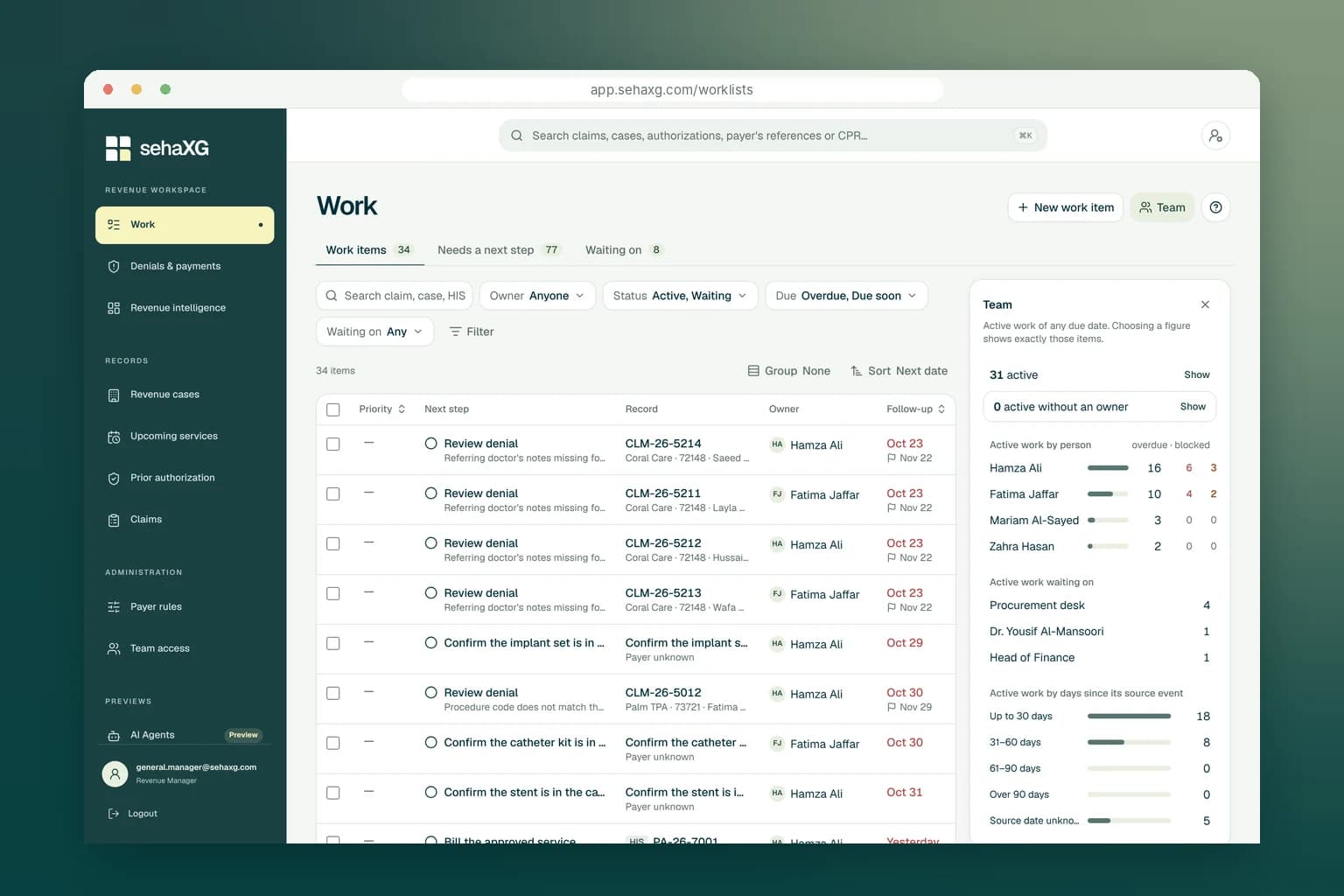
When a revenue team opens its A/R queue, it needs more than a list sorted by oldest or largest. It needs to know which action could change an outcome today. That means weighing potential recovery, filing deadlines, evidence readiness and the time required to work the case.
01 / WORK TYPES
Do not score an unworkable claim as if it were ready
Separate claims ready for an action today from those waiting on a clinician, contract owner, insurer response or missing remittance. A BHD 1,200 appeal without a required document is an evidence task, not an appeal task. If it sits at the top of a generic A/R queue, staff may repeatedly open it and discover the same blocker. Its next action is to obtain the document, with an owner and due date.
Also distinguish new technical rejections, adjudicated denials, unpaid accepted claims, partial payments and true underpayments. Each has a different pathway and deadline. Keep a claim in only one primary work state, while allowing linked tasks for dependencies. When a payer response arrives, update the state and preserve the history so the team knows why it moved.
02 / THE SIGNALS
Rank the opportunity, not just the balance
An outstanding amount can be large but disputed, or small with a simple correction likely to pay. A practical priority view starts with expected recoverable BHD, not the billed charge. It then considers the likelihood that a known action will work, days until a timely-filing or appeal limit, age, the effort needed and whether the claim belongs to a repeatable cohort.
The score should explain itself. Staff must be able to see which inputs pushed an item up the queue and override a bad ranking with a reason. Otherwise a machine-learning label simply hides the same prioritisation problem inside a number.
- Financial: validated potential payment, not total charges.
- Time: external deadline and how long the next step takes.
- Evidence: whether the approval, contract or appeal documents are ready.
- Repeatability: whether the same fix could resolve a group of claims.
03 / TRANSPARENT SCORING
Use a rule people can challenge
A first-pass ranking can use urgency, validated recoverable BHD, action readiness and likelihood of success. Give a near filing deadline an explicit override, then group cases with the same fix so one worker can handle them together. Do not multiply billed amount by a black-box probability and call that a recovery forecast; the input amount itself may be wrong or already assigned to the patient.
Show a short reason beside each rank: 'appeal due tomorrow; approval on file; BHD 180 insurer share' is actionable. 'Priority 92' is not. Let staff override the order and record why. Those overrides reveal missing signals, such as a payer outage, a new contract interpretation or a clinician unavailable to sign an appeal. Revisit the weights with observed outcomes instead of treating the first formula as permanent.
- Urgent: time-sensitive, valid action with evidence ready.
- High return: large or repeatable validated opportunity with a plausible route.
- Blocked: dependency owner and due date, not a misleading ready-to-work score.
04 / BHD EXAMPLE
The smaller claim may need attention first
Suppose Task A has BHD 1,200 at stake but no supporting documentation yet, a low chance of immediate recovery and 25 days before the appeal deadline. Task B is a BHD 180 correction with a valid approval already on file and a deadline tomorrow. Task B is the better first action even though its balance is smaller.
This is not a fixed formula for every hospital. Some teams will have minimum balance rules or strategic payer issues that change the order. The point is to make the reason explicit and keep urgent, solvable work from disappearing below a large but immovable balance.
BHD 180 before BHD 1,200
Assign the BHD 180 correction now, with its approval evidence attached and an owner before tomorrow's deadline. Keep the BHD 1,200 case visible as an evidence-gathering task rather than pretending it is ready to appeal.
Put the BHD 180 correction at the top today
sehaXG can place the BHD 180 claim with tomorrow's deadline and a matching approval above the BHD 1,200 appeal that still lacks clinical evidence. The worklist explains the order in plain language, routes the first correction to an owner and creates a separate document-gathering task for the larger case.
As acknowledgements and payments arrive, the same cases update rather than spawning duplicate tasks in separate dashboards. A manager can inspect overrides and the unworked tail to see when the priority rule is missing a real opportunity.
Explore sehaXG Orchestration05 / TEAM WORKFLOW
Turn an alert into owned work
A manager should be able to assign one claim or a coherent batch to a person or team, set the due date, and see the next action. Each task needs a record of status checks, documents gathered, insurer contact, submission receipt and outcome. Bulk assignment saves time only when the cases really share a fix; otherwise it spreads an error quickly.
Keep duplicate tasks from different dashboards out of the queue. When an alert creates a work item, link the two. When the claim pays, closes or changes owner, update the worklist and leave the audit trail intact.
06 / TEAM CADENCE
Turn priority into a realistic day of work
At the start of the day, review deadlines first, then group ready cases by insurer and action so staff can reuse context. Check the previous day's insurer responses and remove paid or closed cases. Assign bounded batches with a named owner and a clear definition of completion: acknowledgement received, appeal accepted, payment posted or documented closure. A case should not vanish from the queue merely because an email was sent.
Reserve time for exceptions. Clinical questions, disputed contract readings and older low-confidence balances need human attention even when they score poorly. A manager should inspect whether the team is clearing only easy claims while complex high-value cases age. The worklist should make capacity constraints visible so leadership can decide whether to reassign work, negotiate with a payer or change an upstream process.
07 / MANAGER CHECK
Watch what the ranking misses
Review the unworked tail each week: small balances, older cases and low-confidence records. Several low-value claims may share one cause and become worth a batch action. Also inspect cases repeatedly scored as 'unlikely'—the model may be missing a newly available payer route or a changed contract term.
Measure payment recovered, deadlines met, time per resolved case and staff overrides. A worklist has succeeded when it helps people make better decisions and complete follow-up, not merely when the top row looks more sophisticated.
08 / OUTCOME REVIEW
Track movement from action to cash
Measure time from payer response to first action, percentage of external deadlines met, claims worked per staff hour, BHD actually recovered, and aging of cases by work state. Track the share of tasks reopened because the first action was incomplete. These metrics are more useful than a daily count of rows clicked or calls made, which can rise while collection slows.
Review the unworked tail by value and cause every week. A cluster of BHD 10 balances may deserve a batch fix; a cluster of stalled BHD 1,000 appeals may reveal a missing clinical hand-off. Compare before and after a prioritisation change using the same payer and service cohorts. If recovery improves only because more staff hours were added, the ranking itself may not be responsible.
THE NEXT STEP
Make today's next action obvious
sehaXG's worklist direction is to connect payer signals, claim-level evidence and human ownership. Start with a transparent priority rule, inspect the exceptions and improve it using verified outcomes.